The Silurian Period:
About:
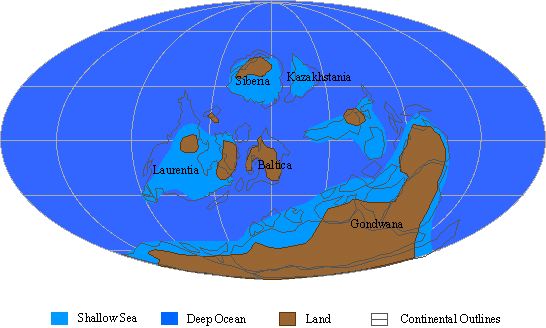
The Silurian period is the earliest period recorded in this paleontology, 443-447 million years ago. It was a time when the Earth underwent considerable changes that had important repercussions for the environment and life within it. The Silurian witnessed a relative stabilization of the earth's general climate, ending the previous pattern of erratic climatic fluctuations. One result of these changes was the melting of large glacial formations. This contributed to a substantial rise in the levels of the major seas.
Globe:
Coral reefs made their first appearance during this time, and the Silurian was also a remarkable time in the evolution of fishes. Not only does this time period mark the wide and rapid spread of jawless fish, but also the highly significant appearances of both the first known freshwater fish as well as the first fish with jaws. It is also at this time that our first good evidence of life on land is preserved, including relatives of spiders and centipedes, and also the earliest fossils of vascular plants. -www.ucmp.berkeley.edu
Inhabitants:
The inhabitance of this period is mostly aquatic as evolution has only started its course to land. Our first ancestors were in this period.
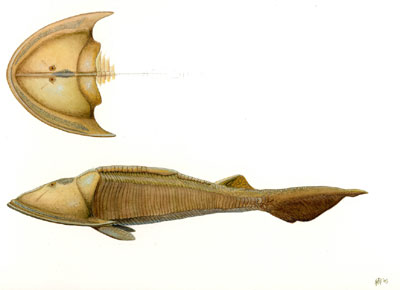 Cephalaspis was a genus of armored, goldfish-sized to trout-sized detritivorous fish that lived in freshwater streams and estuaries of early Devonian Western Europe. Although it was heavily armored, this fish was an osteostracan cephalaspidomorph fish, and should not be confused with its jawed contemporaries, the placoderms.
Like its immediate osteostracan ancestors, Cephalaspis was heavily armored, presumedly to defend against predatory placoderms and eurypterids, as well as to serve as a source of calcium for metabolic functions in calcium-poor freshwater environments. It had sensory patches along the rim and center of its head shield, which were used to sense for worms and other burrowing organisms in the mud.
Because its mouth was situated directly beneath its head, Cephalaspis was thought of as being a bottom-feeder, akin to a heavily armoured catfish or sturgeon. It used its plow-like head shield to dig up worms or crustaceans hidden in the mud, as well as sift through detrius. -Wikipedia
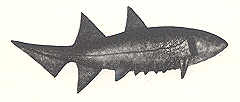 Acanthodii is a class of extinct fishes, having features of both bony fish (Osteichthyes) and cartilaginous fish (Chondrichthyes). They appeared in the early Silurian (430 mya) and lasted until the late Permian (250 mya). The earliest ancanthodians were marine, but during the Devonian, freshwater species became predominant. They are distinguished in two respects: they were the first known jawed vertebrates, and they had stout spines supporting their fins, fixed in place and non-movable (like a shark's dorsal fin).
There were three orders: Climatiiformes, Ischnacanthiformes and Acanthodiformes. Climatiiforma had shoulder armor and many small sharp spines, Ischnacanthiforma with teeth fused to the jaw, and the Acanthodiforma were filter feeders, with no teeth in the jaw, but long gill rakers. The scales of Acanthodii are unique and used in determining relative age of sedimentary rock. The scales are tiny, with a bulbous base, a neck, and a flat or slightly curved diamond-shaped crown. -Wikipedia
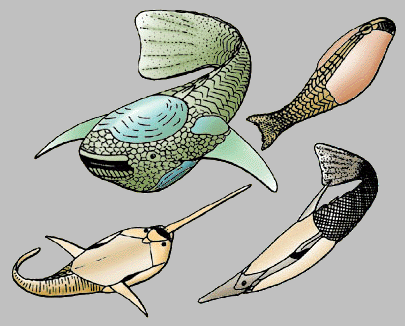 Heterostraci or 'Different scales' is a jawless vertebrate that lived primarily in marine and estuary environments. They lived on until the late devonian period. Most heterostracans had two plates which form a large dorsal shield and a large ventral shield, and had series of scales arranged in various patterns on the sides of their bodies, the exact pattern differing from one group to another. In a few primitive forms, such as Lepidaspis, the dorsal and ventral shields are composed of a mosaic of tiny scales. In all other forms, though, these tiny scales have fused together to form the shield-plates.The scales of heterostracans are histologically distinct from other vertebrates, having three layers composed of dentine and aspidine. The middle layer was honeycombed with tiny spaces called "cancella."
Heterostraca is divided into two main groups, the orders Cyathaspidiformes ("Cup Shields"), and Pteraspidiformes ("Wing Shields"). The Silurian heterostracan Athenaegis is regarded as being the sister group of both orders, while the Early Devonian Lepidaspis is regarded as being sedis mutabilis. Cyathaspidiformes is divided into two main groups: the Amphiaspida of Early Devonian Siberia (grouped together with their relative Ctenaspis), of Canada, and the Cyathaspidida (grouped together with their relative Nahanbiaspis. The Pteraspidiformes is divided up into five families, Anchipteraspididae, Protopteraspididae, Pteraspididae, Protaspididae, and Psammosteidae. -Wikipedia
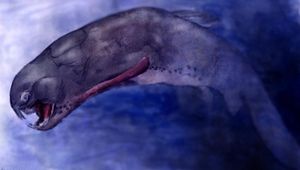 Placodermi were armoured fish that lived from the late silurian to the late devonian. Their head and thorax were covered by articulated armoured plates and the rest of the body was scaled or naked. Placoderms were among the first of the jawed fish, their jaws likely evolving from the first of their gill arches. The first identifiable Placoderms evolved in the late Silurian; they disappeared in the Late Devonian extinctions. The first appearance of late Silurian placoderm fossils, in China, show the fishes already differentiated into Antiarchs and Arthrodires; apparently Placoderm diversity originated long before the Devonian, somewhere in the early to middle Silurian, possibly in China (where fragments of late Silurian antiarchs and arthrodires have been found), though earlier fossils of basal Placodermi, have yet to be discovered in these particular strata. -Wikipedia
Astraspidida are a marine taxon of vertebrate. The are often grouped together with the Arandaspidida which are very much alike. The oldest fossils are thought to be circa 460 million years old. Unfortunatly, no image availible.
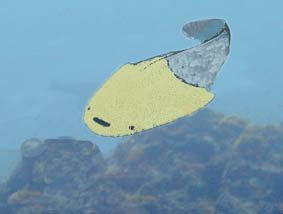 Thelodonti or 'nipple teeth' were very similar to the Heterostraci, though were not heavily armored. They are covered with distinctive, small, spiny scales, which are their most common fossils. They lived in both freshwater and marine environments during the Silurian and Devonian periods. -Wikipedia
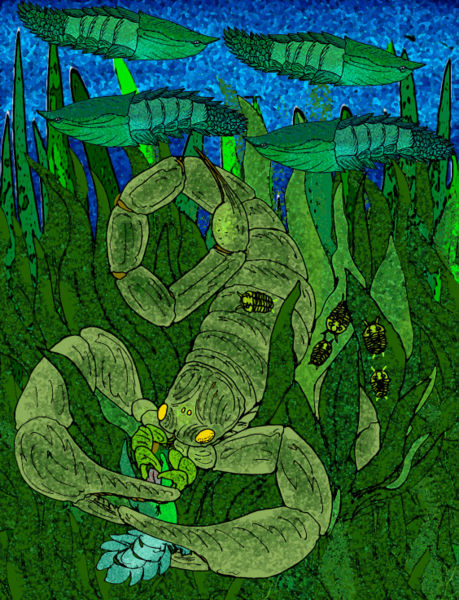 Brontoscorpio Anglicus or 'EnglishThunder Scorpion' was a 1-meter long, aquatic scorpion that lived during the Silurian period. When alive, B. anglicus would have resembled an oversized scorpion, albeit with relatively large (for a scorpion) compound eyes, and was an important predator of its time, given as how the arthropods were among the largest animals on Earth during the Silurian.
Obviously, given as how all post-Paleozoic scorpions are all terrestrial, and that many of the known Paleozoic scorpions, such as Paleophonus, made the transition from aquatic to terrestrial environments during the Silurian, it has been strongly inferred that B. anglicus was capable of leaving the water and entering land, whether to evade other predators, such as large nautiloids, eurypterids, or even other aquatic scorpions, or pursue prey, such as other, smaller terrestrial scorpions. However, given its great size, B. anglicus had to remain in water (or return to it) whenever it molted its exoskeleton, as on land, it would otherwise be crushed by its own weight. Marine scorpions such as B. anglicus, captured, stung, and ate small sea animals such as fish like acanthodians, heterostracans, smaller scorpions and trilobites. -Wikipedia