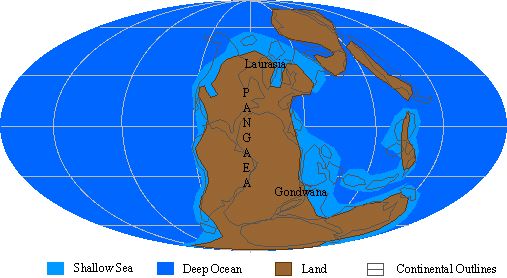
The Permian Period
Aquatic Carniferous Hebiferous Aerial
About:
Because of the increase in land mass and the warmer climate, the Permain period was a harsh time, with very little water and vegetation, meaning a lack of herbivores, meaning a lack of carnivores. Most land was but dry desert and dusty canyons. The early permain wasn't as bad as vegetation was higher along with better water levels, but still, the weather was hot, so some creatures grew sails to keep them cool.
Globe:
Inhabitants:
The creatures of this period were adapted for the hot and the dry, yet not perfectly adapted, this time was so bad, many creatures became extinct.
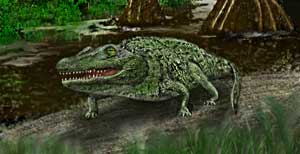 Eryops or 'Dawn-out face' because most of its skull was in front of its eyes. Eryops is an example of an animal that made successful adaptations in the movement from a water environment to a terrestrial one. It retained, and refined, most of the traits found in its fish ancestors. Sturdy limbs supported and transported its body while out of water. A thicker, stronger backbone prevented its body from sagging under its own weight. Also, by utilizing vestigial fish jaw bones, a rudimentary ear was developed, allowing Eryops to hear airborne sound. -Wikipedia
 Mesosaurus brasiliensis or 'Middle lizards' were small marine reptiles, the first aquatic reptiles, having returned to a watery way of life after evolving on land. -Wikipedia, edited.
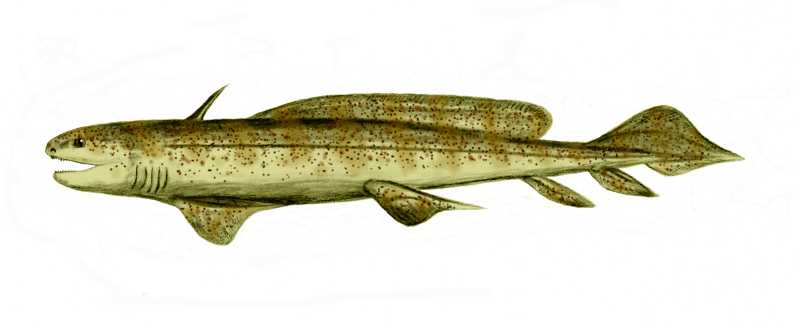 Orthacanthus was the terror of freshwater swamps and bayous in Europe and North America. Its body reached nearly 10 feet in length and its powerful jaws were lined with double-fanged teeth. Related to the Xenacanthus.
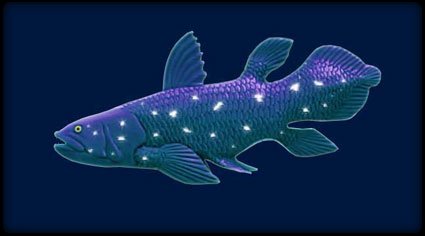 Sarcopterygii is traditionally the class of lobe-finned fishes, consisting of lungfish and coelacanths. These are bony fish with paired rounded fins. These fins, being similar to limbs, suggest that these fish may be ancestors of land vertebrates. Most taxonomists who subscribe to the cladistic approach include within this group the superclass Tetrapoda, which in turns consists of all species of four-limbed vertebrates. The fin-limbs of sarcopterygiians show such a strong similarity to the expected ancestral form of tetrapod limbs that they have been universally considered the direct ancestors of tetrapods in the scientific literature.
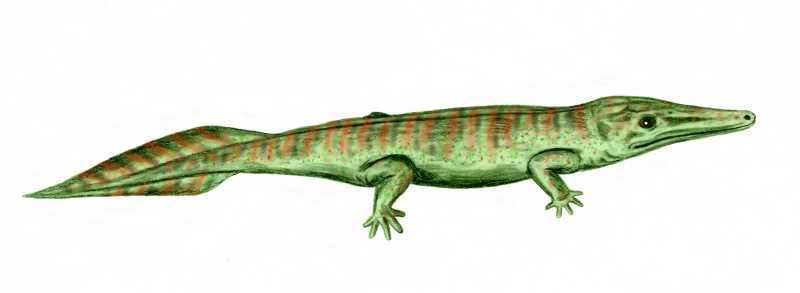 Archegosaurus Decheni or 'Goldfuss' very much like a crocodile, but with a long snout and lacking armour.
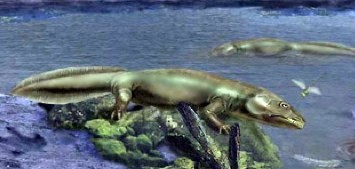 Labyrinthodont are an ancient, extinct Amphibian group thus named because of thelabyrinthine internal structure of their teeth. They were the first Vertebrates to begin the conquest of solid ground. The Vertebrates' passage from aquatic environments to subaerial ones took place in the Devonian period, when Vertebrates that had lived in a liquid medium for nearly 150 million years started to populate dry land.
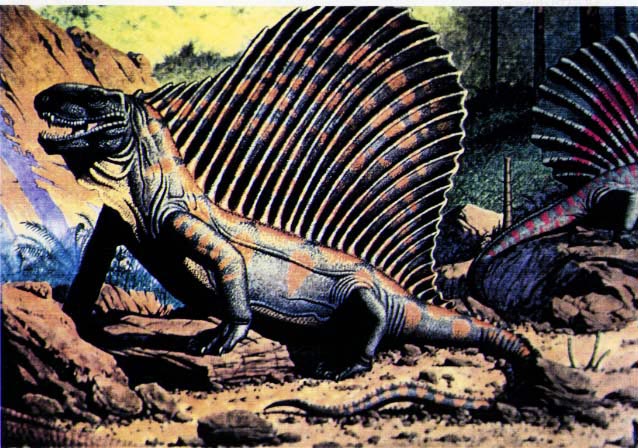 Dimetrodon Grandis is the ancestor of the mammals belonged to the family called Pelycosaurs, which had both mammal and reptile characteristics. Dimetrodon preceded the earliest dinosaurs by more than 40 million years but physically it looked a lot like one. It is often referred to as mammal-like reptile, based on characteristics of the skull and dentition. Dimetrodon was a dominant carnivore, the largest one of the Permian period. It was a predacious reptile that was on the top of the food chain during the early Permian. This pelycosaur possessed a spectacular sail on its back, supported by long, bony spines, each of which grew out of a separate spinal vertebra. The sail was probably an early experiment in controlling body temperature. It is believed that the sail absorbed the heat of the sun and warmed the blood and body. It warmed up early after sunrise and cooled off more efficiently during the heat of the day. It may have also been used for mating and dominance rituals and making it look much larger than it was to predators. Dimetrodon had a large skull with two types of teeth (sharp canines and shearing teeth). It was probably quite slow because it walked on four side-sprawling legs. -Prehistory.com
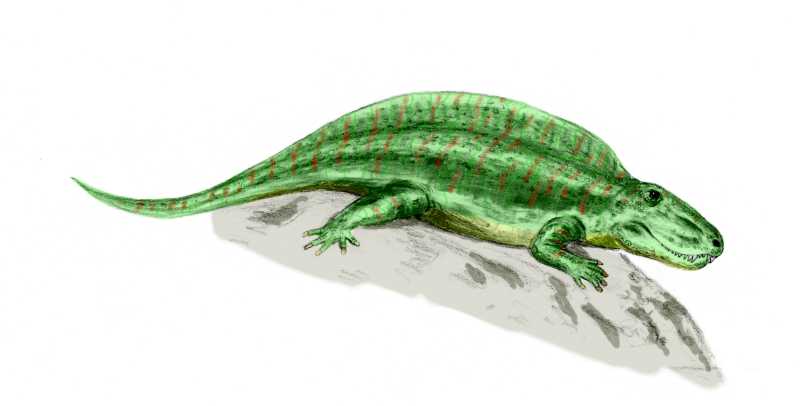 Sphenacodon was a pelycosaur that was 10 feet in length. As it name suggests, Sphenacodon belongs to the family Sphenacodontidae, a lineage that was related to Therapsids. Sphenacodon's vertebral spines were long, and probably acted as attachment points for massive back muscles, allowing the animal to lunge powerfully at its prey. Though the spines were long, it did not have a sail like Dimetrodon. However, it was closely related to Dimetrodon and other sphenacodontids. Sphenacodon lived in Early Permian in the North American region, more specifically, in Texas and New Mexico. -Wikipedia
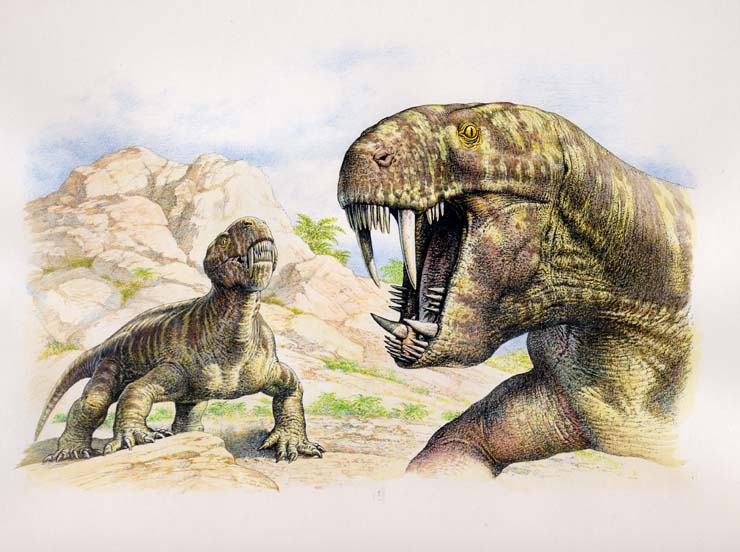 Gorgonops or 'Gorgon (Mythical Creature) Face', also known as Gorgonopsid or Gorgonopsian, along with Dinogorgon and Lycaenops dominant predators of their day, which in the largest forms grew to over 4 meters long and had evolved canine teeth, as well as other traits associated with its mammalian descendants. Arguments have even been made for synapsids of its time being warm-blooded, though no strong evidence exists either way. -Wikipedia
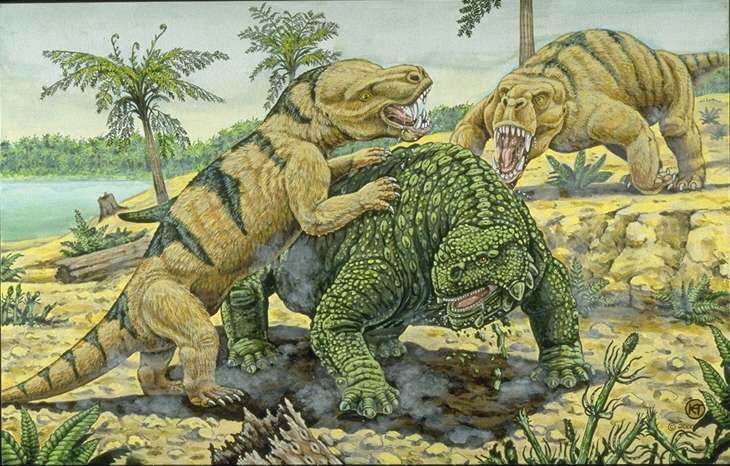 Dinogoron or 'Terrible Gorgon (Mythical Creature)' is estimated as the size of a bear, like the Gorgonops, whether this creature was reptile or mammal was arguementanive. In the picture to the right, a pair of Dinogorgon are attacking a Pareiasaur.
 Lycaenops or 'Wolf Face' was a lightly built carnivore with long legs. It was 1 meter long, and very much like a wolf with a very long set of dog-like canine teeth set into both upper and lower jaws. Pointed canine teeth were ideal for stabbing and tearing at the flesh of large prey. It probably hunted small vertebrates such as reptiles, small pelycosaurs, and dicynodonts such as Robertia and Cistecephalus, as well as larger dicynodonts. Lycaenops may have been a pack animal, living and hunting with others of its kind. Lycaenops walked and ran with its long legs held close to its body. This is a feature found on mammals, but not in more primitive amniotes and synapsids, such as the pelycosaurs and early reptiles whose legs are positioned to the sides of their bodies. The ability to move like a mammal would have given Lycaenops an advantage over other land vertebrates/animals, since it would have able to out-run them. -Wikipedia, edited.
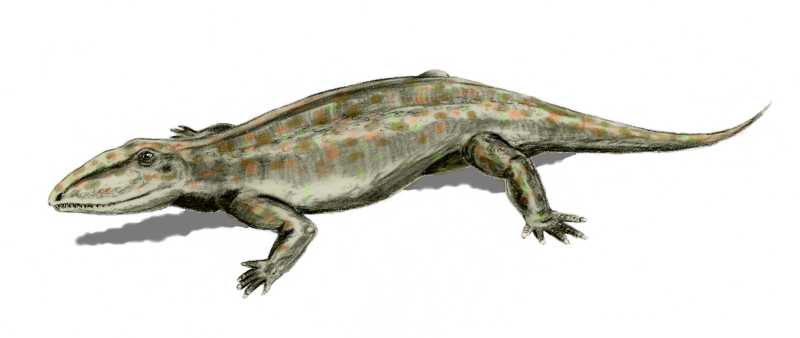 Ophiacodon is a large synapsid pelycosaur. It is at least two meters in length, the largest ones were 2.5 meters (8 feet), and the smaller ones were 1.5 meters (6 feet). Ophiacodon 's size increases as time progresses during the Early Permian epoch until its extinction at the end of the epoch. It is a specialized member of the ophiacodontid family lineage. Being the most famous ophiacodontid in the family, its fossils were found in North America. The skull was deep, with long jaws, and provided with sharp teeth. Ophiacodon may have eaten fishes in streams and ponds, although the high narrow skull would seem to mitigate against such a lifestyle. It's related to other ophiacodontids, such as Archaeothyris, and its ophiacodontid relatives seem to be ancestral to all synapsids, including mammals. -Wikipedia
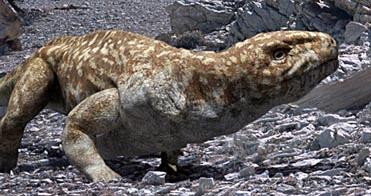 Seymouria was small, only 2 ft (60 cm) long. Seymouria was well adapted to life on land, with many reptilian features--so many, in fact, that it was first thought to be a primitive reptile. The dry climate of the Permian suited reptiles better than amphibians, but Seymouria had many reptilian features that helped it in this environment. It had long and muscular legs, and may have had dry skin and an ability to conserve water. It may have been able to excrete excess salt from its blood through a gland in its nose, like modern reptiles. All of this meant that Seymoria, unlike amphibians and other early tetrapods, might have lived for extended periods of time away from water. If so, this would have allowed it to move about the landscape in search of insects, small amphibians, and other possible prey items, such as the eggs of reptiles. Male Seymouria had thick skulls that may have been used to batter rivals in mating contests. After mating, the females would have had to return to water to lay their eggs. As in amphibians, the larvae would develop in water, hunting for worms and insects until they were strong enough to live on land. While no larvae are known from Seymouria itself, fossil larvae of other species in the order Seymouriamorpha have been found, with impressions of external gill structures as in some amphibians. Fossils of Seymouria were first found in Seymour, Baylor County, Texas (hence the name of the type species, Seymouria baylorensis, or "Baylor County Seymour one"). Over the years, many well preserved fossils have been found in North America and Germany, including the "Tambach Lovers", two individuals of S. sanjuanensis fossilized lying next to each other (though of course it cannot be determined whether they really ware a couple killed during mating).
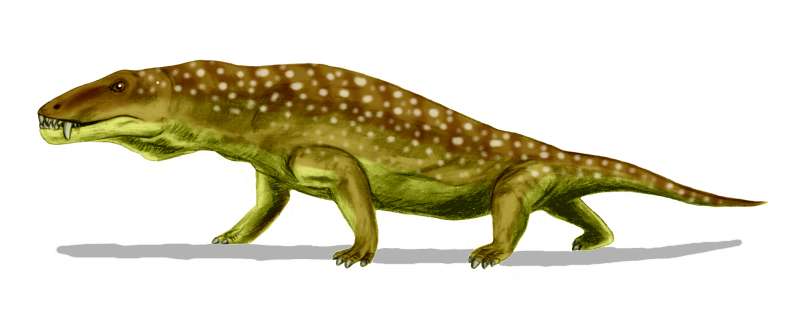 Antoesaurus Magnificus had shorter back legs than it's front legs, it lived in south Africa and was mammal-reptile.
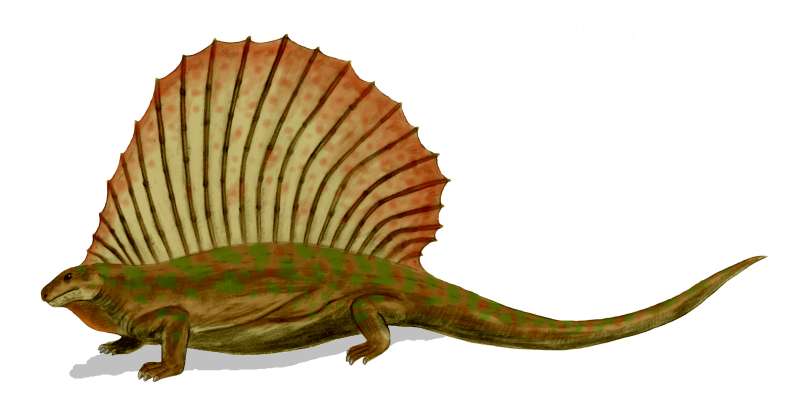 Edaphosaurus or 'Earth Lizard' Along with the Diadectidae, Edaphosaurus is one of the earliest known plant-eating animals. It had a remarkably small, short and shallow skull, a wide body and thick tail. On its back is a sail, different in shape to that of its contemporary Dimetrodon, the vertebral spines being shorter and heavier and bearing numerous small cross bars. -Wikipedia
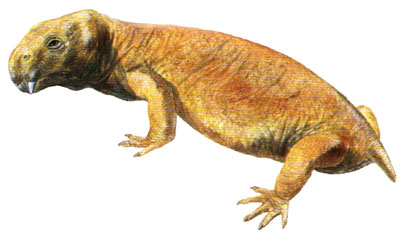 Robertia Broomiana was a small, primitive dicynodont; among the earlier members of the group. It is known from the Tapinocephalus assemblage zone of the South African Karoo, and was about 20 cm in length. It is characterised by a moderately wide skull roof, small postcanine teeth, and the palatine bone in the roof of the mouth not as reduced as in its more successful relative Diictodon. Immediately in front of the tusk-like canines on the upper jaw is a notch, which would presumably hold tough plant matter like stems and twigs before these were severed by the horny beak. -Wikipedia
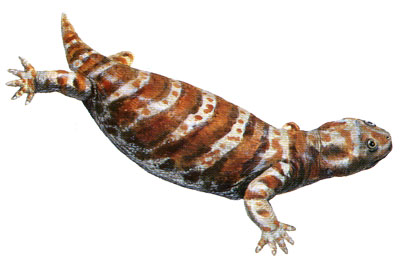 Cistecephalus was a small, specialised, burrowing dicynodont, a kind of reptilian mole. The head is flattened and wedge-shaped, the body short, and the forelimbs very strong, with similarities in structure to the forelimb of modern burrowing mammals. -Wikipedia
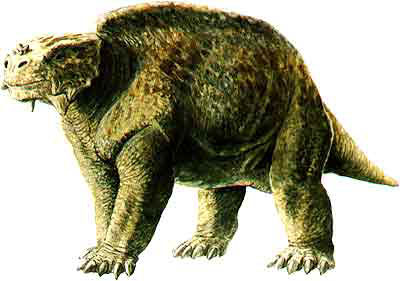 Scutosaurus or 'shield Lizard' was a genus of armor-covered pareiasaur, perhaps as much as 3 to 6 meters (10 to 20 feet) long. It was a large anapsid reptile that, unlike most reptiles, held its legs underneath its body to support its great weight. It was an herbivore, which probably lived in herds and was adapted to the dry conditions which covered much of Pangaea at that time. It was of a very heavy build, almost rhinoceros-like. -Wikipedia
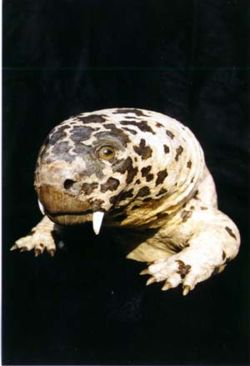 Diictodon had proportionally large heads that ended in a horny beak. Both males and females had a pair of tusks sticking out from the upper jaw, with those of the male being slightly larger. Diictodon had strong arms and legs, as well as 5 sharp claws on each hand, and may have had keen senses of smell and sight. Thir spines moved side to side as they walked. Their jaws were also simplified, with some of the bones dedicated instead to hearing, considered a key sign of mammalian adaptation.
As a therapsid, Diictodon shared many features with modern day mammals. Most noticeably, they made burrows into the earth. These burrows could be up to 1.5 m (5 feet) deep. Many scientists believe that Diictodon lived like the modern gopher. These could have been used to escape the heat of the desert, which was the dominant environment on the continent of Pangaea in the Late Permian Period. Inside these burrows, nests have been found, where Diictodon skeletons are sometimes found in pairs. This suggests that the two Diictodon (a male and a female) mated for life. Many Diictodon, however, nested close to flood plains, and some specimens may have been killed as water flowed into the nests, drowning the animals. Diictodon had no known rival species competing in its niche, so they may have competed primarily with others of their species for the little plant material available.
Like all dicynodonts, Diictodon were herbivorous. They used their beaks to break off pieces of the sparse desert shrubs. Like modern desert animals, Diictodon may have had unusually efficient digestive systems, due to the lack of nutrients present in desert plants. As burrowing animals, they may have fed off of water-rich plant tubers (roots).
-Wikipedia
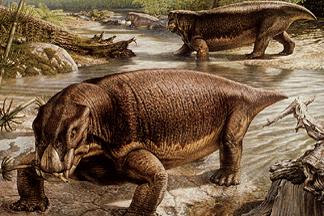 Lystrosaurus was a mammal like reptile about the size of a dog and resembling a small hippo. They were believed to have similar habits to that of the present day hippopotamus, living in swamps and wetlands and browsing on vegetation, providing proof that Antarctica was once a warm green continent covered in trees and plants. Also supported by the evidence of coal reserves found within the range. -http://home.freeuk.com/gtlloyd/tam/palaeo.htm, edited.
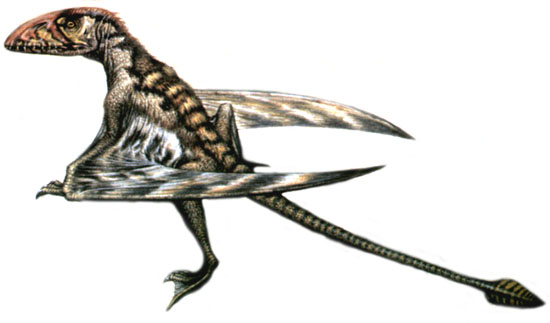 Dimorphodon or ' Two-form Teeth' was a genus of medium-sized pterosaur from the Early Jurassic Period. It was named by paleontologist Richard Owen in 1859. Dimorphodon means "two-form tooth" (Greek di meaning 'two', morphe meaning 'shape' and odon meaning tooth), referring to the fact that it had two distinct types of teeth in its jaws - which is comparatively rare among reptiles. Fossil remains have been found in England. Mary Anning (1799 - 1847) was famous for her Dimorphodon (D. macronyx) discovery at Lyme Regis in Dorset, UK. This region of Britain is now a World Heritage Site, dubbed the Jurassic Coast. Dimorphodon was approximately 1 m (3.3 ft) long, with a 1.2 m (4 ft) wingspan.
It has been argued that Dimorphodon was a biped, though fossilised track remains of other pterosaurs (ichnites) show a quadrupedal gait while on the ground. Its teeth and jaws suggest it was, like most pterosaurs, a piscivore (fish eater). Most depictions display a puffin-like 'beak'.
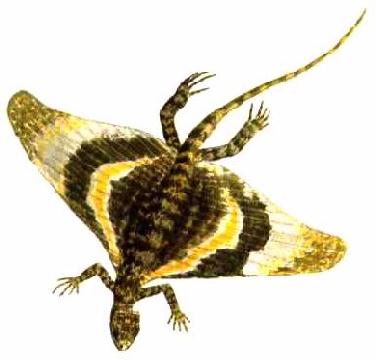 Coelurosauravus specialized wing-like structures allowing it to glide. These were rod like structures with skin stretched over them; this features is unique to this genus. The average length of the specimens were 60 cm and the body was long and flat, suitable for its gliding nature. The skull was lizard-like with a pointed snout and contained a broad back with a serrated crest, like Ceratopsians. It lived during the Permian period in what is now Germany.