The Devonian Period:
About:
The Devonian period is the second earliest period recorded in this paleontology, 395-345 million years ago. The first tetrapods which are land living vertebrates entered existance in this period, accompanied by the first terrestrial arthropods, containing wingless insects and the primitive arachnids. Aquatic life was large in population aslo, because most creatures haven't evolved to live on land yet, unlike now.
Globe:
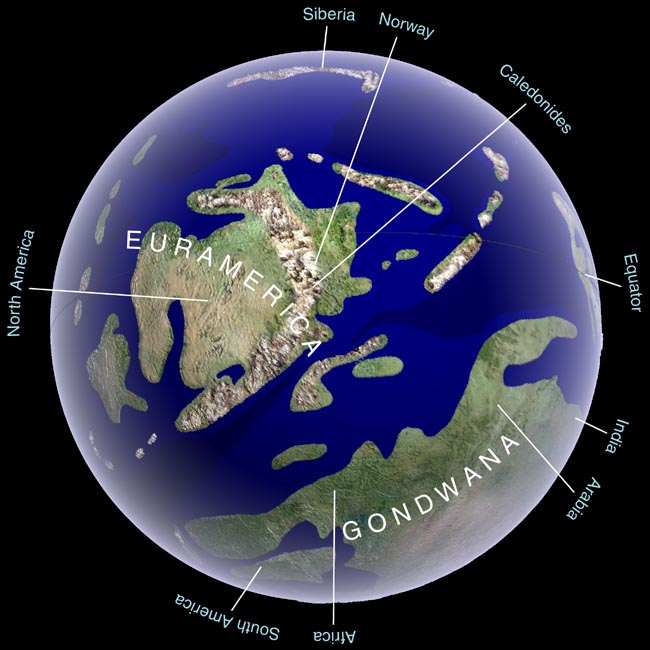
The Devonian world was two supercontinents, the rest of the globe covered by ocean. Plant life was basic and low in quantity, near the end of this period, vertebrates moved onto land.
Inhabitants:
The inhabitance of this period is mostly aquatic and insect. Due to the higher oxygen levels, insects grew somewhat, bigger...
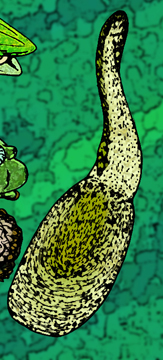 Lepidaspis Serrata or 'Serrated Scaley Shield' had no jaws, Its genus name refers to the fact that the shield is composed of hundreds of tiny scales.
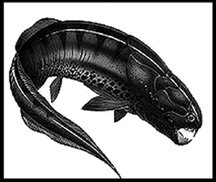 Dunkleosteus was a "spiny shark" that could get up to 30 feet long. It lived in many areas of the world including parts of the United States, such as Ohio and California. It had thick, bony plates on it's large head (its head was 1/3 of its body) and a smooth, scaleless, eel-like body. The large fish was feared by the other fish it shared the seas with. Its close relatives were the Dinichthys and the Titanichthys.
 Hynerpeton Bassetti, the first late devonian tetrapod on record, discovered. They could walk on land but had to stay near water so that they can stay damp. They would mate on land and lay their spawn on land but by water.
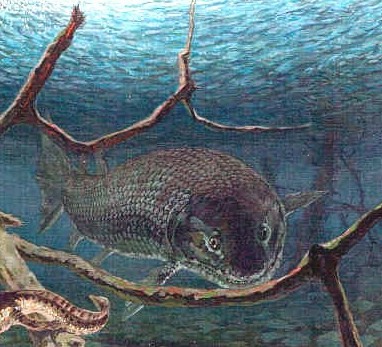 Hyneria was approximately three to four meters in length and weighed as much as two tons. Fossilized teeth, bones and a tail fin were found at Red Hill. Hyneria was a member of the family Tristichopteridae, along with its close relative Eusthenopteron. -Wikipedia
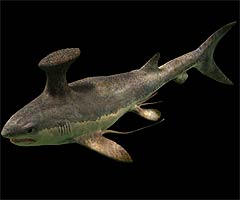 Stethacanthus lived through this period to the carboniferous period. It was approximately almost one meter long. It probably hunted smaller creatures such as small fish. It is best known for its unusually shaped dorsal fin, which resembles an anvil or ironing board. Small spikes (enlarged versions of the dermal denticles commonly covering shark skin) covered this crest, and the shark's head as well. Some scientists think the crest may have had a function in courtship; others think it may have been used for self defence. -Wikipedia
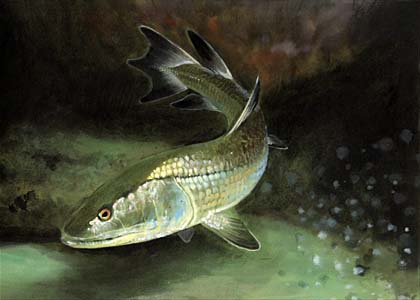 Eusthenopteron had attained an iconic status from its close relationships to tetrapods. Early depictions of this animal show it emerging onto land, however paleontologists now widely agree that it was a pelagic animal. The genus Eusthenopteron is known from several species that lived during the Late Devonian period, about 385 million years ago. Eusthenopteron was first described by J. F. Whiteaves in 1881, as part of a large collection of fishes from Miguasha, Quebec. -Wikipedia
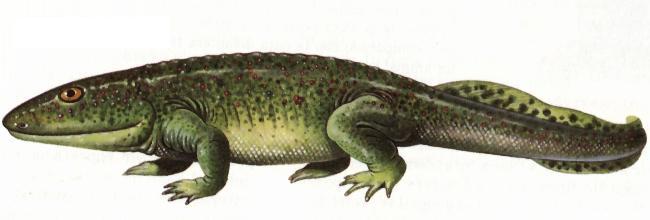 Icthyostega was similar in size to the Eusthenopteon, however, these creatures were amphibian, perfectly adapted to the swamp way of life.
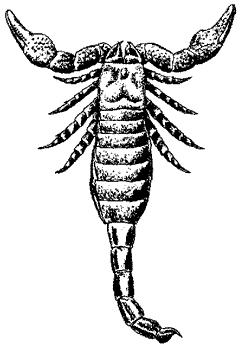 Protoscorpion Paleophonus was a large scorpion but like any other scorpion today, except it was bound by water as it had gills. It woulod hunt smaller fish like its ancestors, eg: Brontoscorpio.