The Carboniferous Period:
About:
The Carboniferous period is about 359.2 million years ago, it was named for the extensive coal beds of that age found in Western Europe. The first third of the Carboniferous is called the Mississippian epoch, and the remainder is called the Pennsylvanian. Conifer trees were introduced in this important and well-known time period. Known as the 'swamp world, most land was but flooded forests.
Globe:
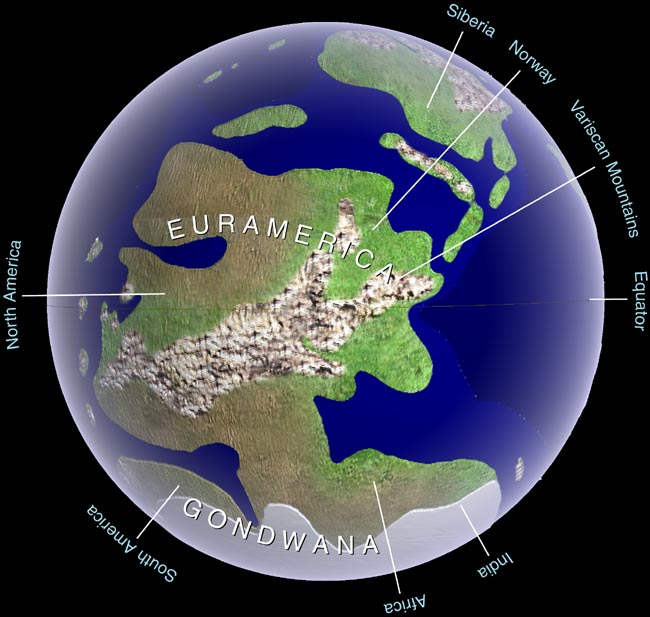
The Carboniferous was a time of active mountain-building, as the supercontinent Pangea came together. The southern continents remained tied together in the supercontinent Gondwana, which collided with North America-Europe (Laurussia) along the present line of eastern North America. This continental collision resulted in the Hercynian orogeny in Europe, and the Alleghenian orogeny in North America; it also extended the newly-uplifted Appalachians southwestward as the Ouachita Mountains.[6] In the same time frame, much of present eastern Eurasian plate welded itself to Europe along the line of the Ural mountains. Most of the Mesozoic supercontinent of Pangea was now assembled, although North China (which would collide in the Latest Carboniferous), and South China continents were still separated from Laurasia. The Late Carboniferous Pangaea was shaped like an 'O'. -Wikipedia
Inhabitants:
Because oxygen levels were so high, everything was big, however the first reptiles to take to only two feet lived in this world, yet they were quite small.
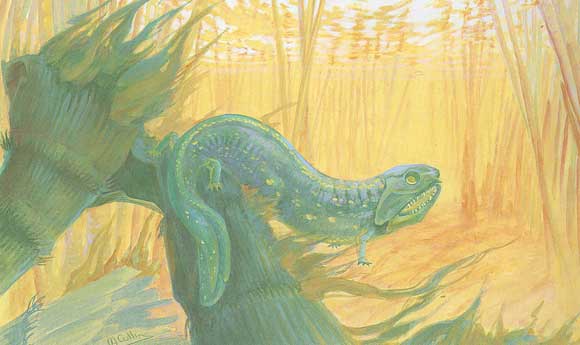 Crassigyrinus Scoticus lived in Scotland and was a large, long-bodied, permanently aquatic predator, with fearsome-looking teeth in a heavily reinforced skull. The snout in particular was consolidated and buttressed, and with a kinetic inertial jaw mechanism, would have produced a bone-smashing snap-trap. Its large eyes were probably adapted for use in murky coal-swampy water. Panchen (1985) envisaged it as behaviourally somewhat analgous to a Moray eel.
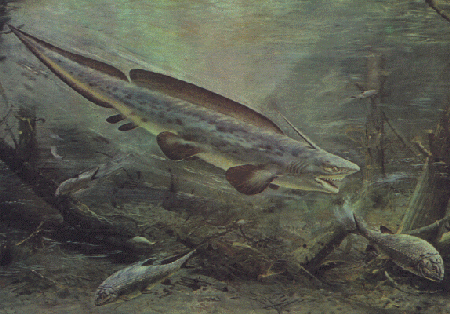 Xenacanthus or 'Shark of soft water' are a well known shark which lives through this period and the next until the Triassic period, which is a very impressive amount of time (Obviously they don't actually 'live' that long, but thats how long their species lived until extintion.)
These giant sharks were the tirants of their land, eating most other species, teeth and bones from the xenacanthus are found a lot.
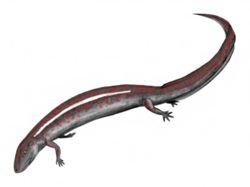 Eogyrinus was one of the largest Carboniferous tetrapods, and perhaps one of the largest of its family. It was 4.6 meters (15 feet) long. Eogyrinus was a powerful swimmer that moved quickly through the water by swishing its long tail from side to side. It may have been a predator, lying in wait in the shadows in much the same way as a crocodile does today. It's lightly built 560kg weight might allow it to do a death-roll, like a crocodile. Although probably better hunting in the water, Eogyrinus could probably make a grab for prey passing close by on land. Eogyrinus is known from Europe, where its fossils were found. -Wikipedia
 Greererpeton Burkemorani was a huge crocodile like creature, perhaps even big enough to be the land tyrant of the Carboniferous period. They had large teeth like a crocodile would and was therefore carniferous. Like modern crocodiles, this beast would hide underwater and wait for thirst prey followed by a strike. Crocodiles today would share each others meal as they need each other to hold large corpses to be able to pull chunks of it. Whether the Greererpeton interacted the same way is however unknown.
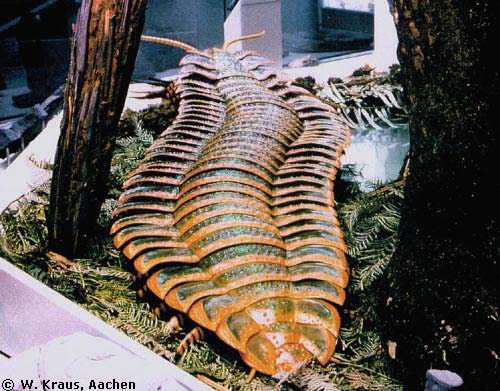 Arthropleura also known as Arthropleurid, was the largest known land invertebrate of all time, and would have had few predators. Arthropleura evolved from crustacean-like ancestors in the Carboniferous, and grew so large because of the high percentage of oxygen in the earth's atmosphere at that time, and because of the lack of large terrestrial vertebrate predators. It became extinct at the start of the Permian period, when the moist climate began drying out, destroying the rainforests of the Carboniferous, and allowing the desertification characteristic of the Permian. Because of this, oxygen levels in the atmosphere began to decline to more modest levels. None of the giant arthropods could survive the new dry, lower-oxygen climate. -Wikipedia Even though Arthropleura were so strong and fierce, they were quite timid and ate mostly wood and dried up plant remains.
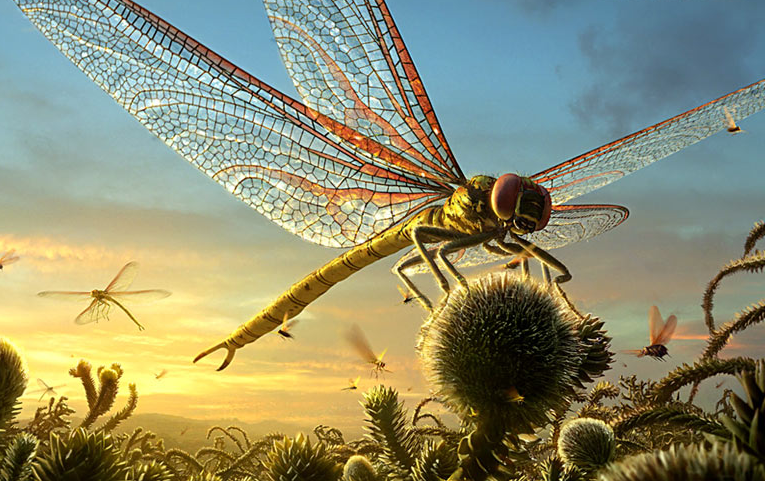 Meganeurid these giant dragonflies were feared predators, they hunted reptiles as backwards as that sounds. They would hunt smaller insects and some reptiles such as Hylonomus. They were fast and perfectly adapted to the swamps of the Carboniferous
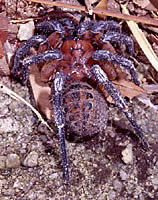 Mesothelae although very spider-like, these creatures are probably more relative to scorpions. Recent Mesothelae are characterized by the narrow sternum on the ventral side of the prosoma. Several plesiomorphic characters may be useful in recognizing these spiders: there are tergite plates on the dorsal side and the almost-median position of the spinnerets on the ventral side of the opisthosoma. They lack a venom gland and duct, which almost all other spiders feature. All Mesothelae have four pairs of spinnerets. Like mygalomorph spiders, they have two pairs of book lungs.
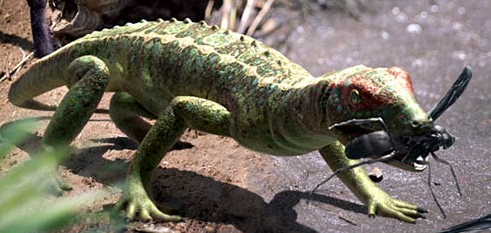 Petrolacosaurus these creatures could be estimated by the size of a cat or small dog. They had distinctive canine-like secondary-sized teeth, a trait normally limited to therapsids and later mammals. -Wikipedia
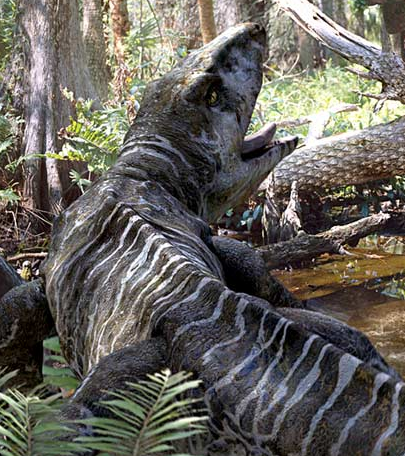 Proterogyrinus or 'earlier tadpole' was up to 2 meters long, it ate smaller creatures such as the aquatic life and the overgrown insects.
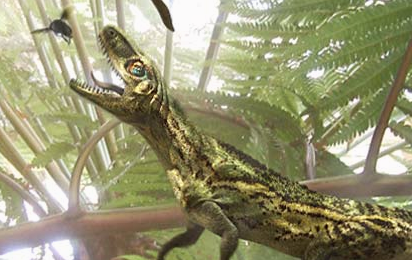 Euparkeria one of the first to stand upon two feet due to their long hind legs, it would still use all fours but could run on two feet (bipedal). These creatures were however small and hunted smaller insects such as Meganeurid.
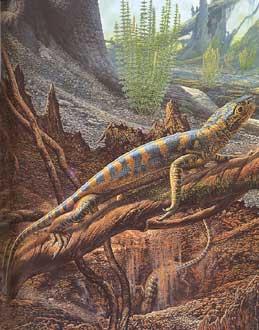 Hylonomus or 'Forest Mouse.' As of 2006 it is the earliest confirmed reptile (Westlothiana is older but may be an amphibian). It was 20 cm long (including the tail) and probably would have looked rather similar to modern lizards. It had small sharp teeth and probably ate millipedes and early insects. It is a precursor of later reptiles. Its predators were the Meganeuria, large arthropods, and other tetrapods such as Eryops, and Archaeothyris. -Wikiperdia
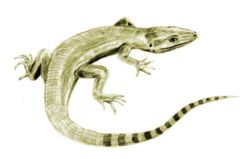 Archaeothyris is one of the oldest synapsids known. It was found in Nova Scotia, the same locality as Hylonomus, Petrolacosaurus, which they resemble, and many other early sauropsids. Unlike the Hylonomus and its kin, Archaeothyris was larger (50 cm, head to tail) and may have also eaten them. Also, Archaeothyris was more advanced than the early sauropsids, its jaws were strong, and the jaws can open wider than the early reptiles. -Wikipedia